
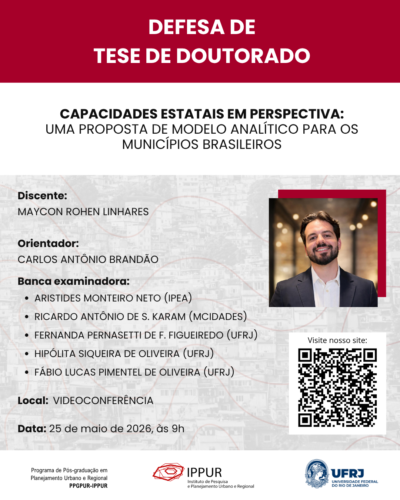
Doctoral Thesis Defense: Maycon Rohen Linhares, May 25, 2026
State Capacity in Perspective: A Proposed Analytical Model for Brazilian Municipalities
Maycon Rohen Linhares
Supervisor: Carlos Antônio Brandão (PPGPUR)
From: PPGPUR
This dissertation analyzes the issue of state capacity in Brazilian municipalities, based on the observation that the proximity between local governments and citizens does not, by itself, ensure a greater ability to formulate, coordinate, and implement public policies. Its main objective is to propose a methodology capable of identifying state capacities at the municipal level and, based on these capacities, classifying municipalities into ideal types that make it possible to understand their relative position and identify priority dimensions for institutional strengthening.
To achieve this objective, the study combines a literature review, conceptual discussion, and methodological development, starting from a critique of approaches that treat state capacity as a one-dimensional phenomenon or that equate it with the final outcomes of public policies. The dissertation argues that state capacity should be understood as a multidimensional concept, distinguishing and relating technical-administrative capacities and political-institutional capacities.
As its main contribution, the study develops an analytical model with two complementary levels. At the first level, it proposes a taxonomy of capacity maturity consisting of four cumulative stages, along with threshold criteria for classifying the institutional proficiency of sectoral policy areas. At the second level, it aggregates these findings into four ideal municipal types, labeled Resilient, Technocratic, Dependent, and Vulnerable.
The dissertation concludes that its primary contribution lies in providing an analytical framework capable of making heterogeneous municipal realities comparable without reducing state capacities to performance indicators. In doing so, it offers a tool for comparative diagnosis, interpretation, and guidance for strengthening local public action, while acknowledging its limitations regarding the causal explanation of the institutional trajectories observed.
