
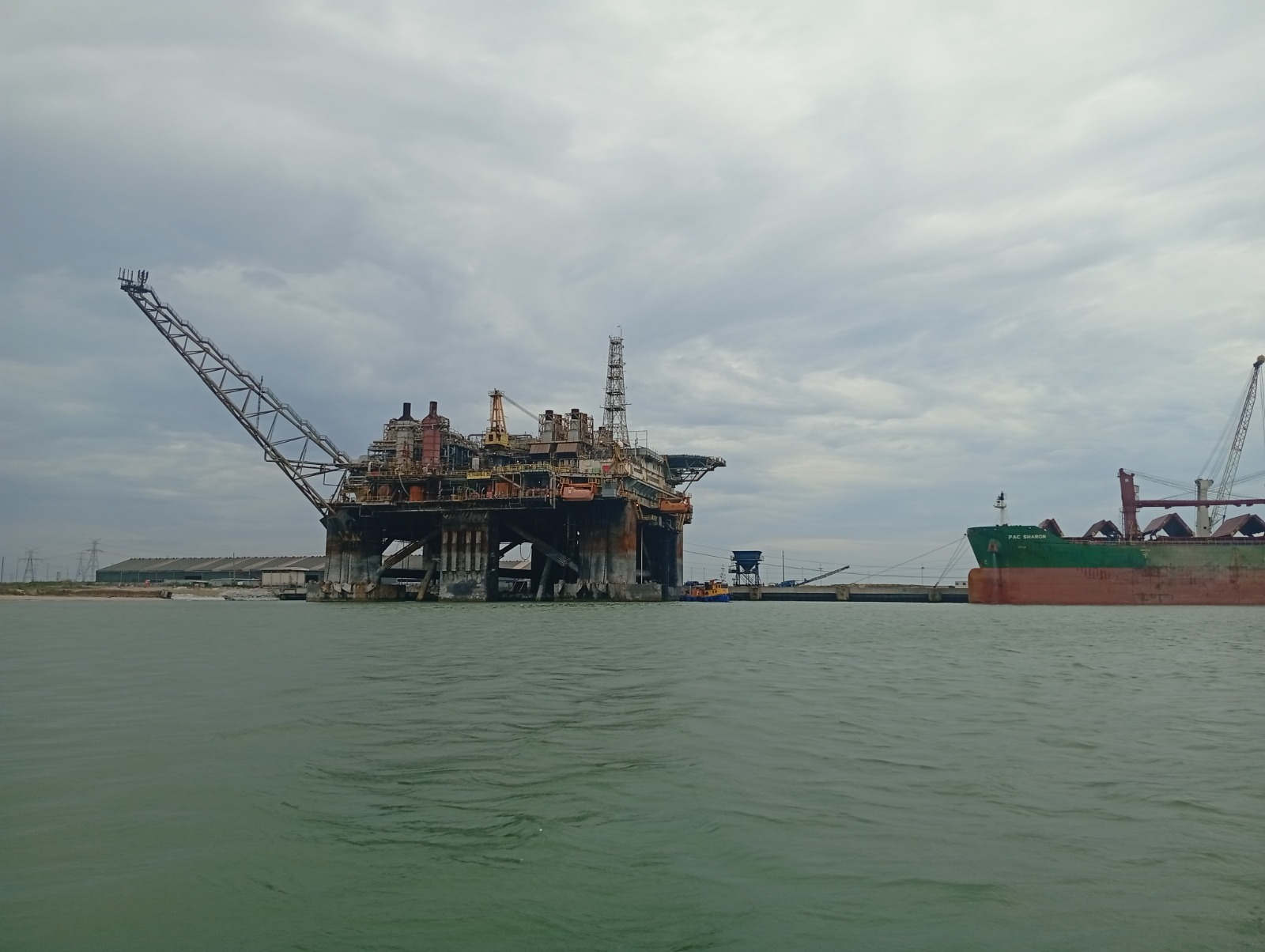
Field research at the Port of Açu investigates the commodification of infrastructures and the effects of the energy transition.
Lucas Reis
Master’s student in Urban and Regional Planning at IPPUR/UFRJ and researcher in the Espacio & Poder group
Deborah Werner
Professor at IPPUR/UFRJ and researcher in the Espacio & Poder group
On October 21–22, 2025, researchers from the Espacio & Poder research group (IPPUR/UFRJ), accompanied by faculty and students from UFF Campos, conducted a field visit to the municipalities of Campos dos Goytacazes and São João da Barra (RJ), focusing on the Port of Açu’s industrial and port complex. The activity is part of the group’s empirical research on infrastructures, markets, and territorialities in the context of the energy transition and directly connects to the debate presented in the Free Session “Market Construction in Contemporary Capitalism: Infrastructure, Nature, and Territorial Control,” at IPPUR Week 2025.
The visit, organized by Professor Leandro Bruno (UFF/Campos), included the participation of faculty members Deborah Werner and Carlos Brandão and researchers Lucas Reis Santos, Jéssica Rossone Alves, and Wander Guerra, all affiliated with IPPUR/UFRJ. Professors Zandor Gomes Mesquita (IF Fluminense/Campos) and Robson Santos Dias (IF Fluminense/Cabo Frio) also participated. Researchers visited port facilities, industrial and logistics areas, and expansion zones linked to offshore wind energy and green hydrogen projects, which are repositioning Açu as a new energy hub in Northern Fluminense.
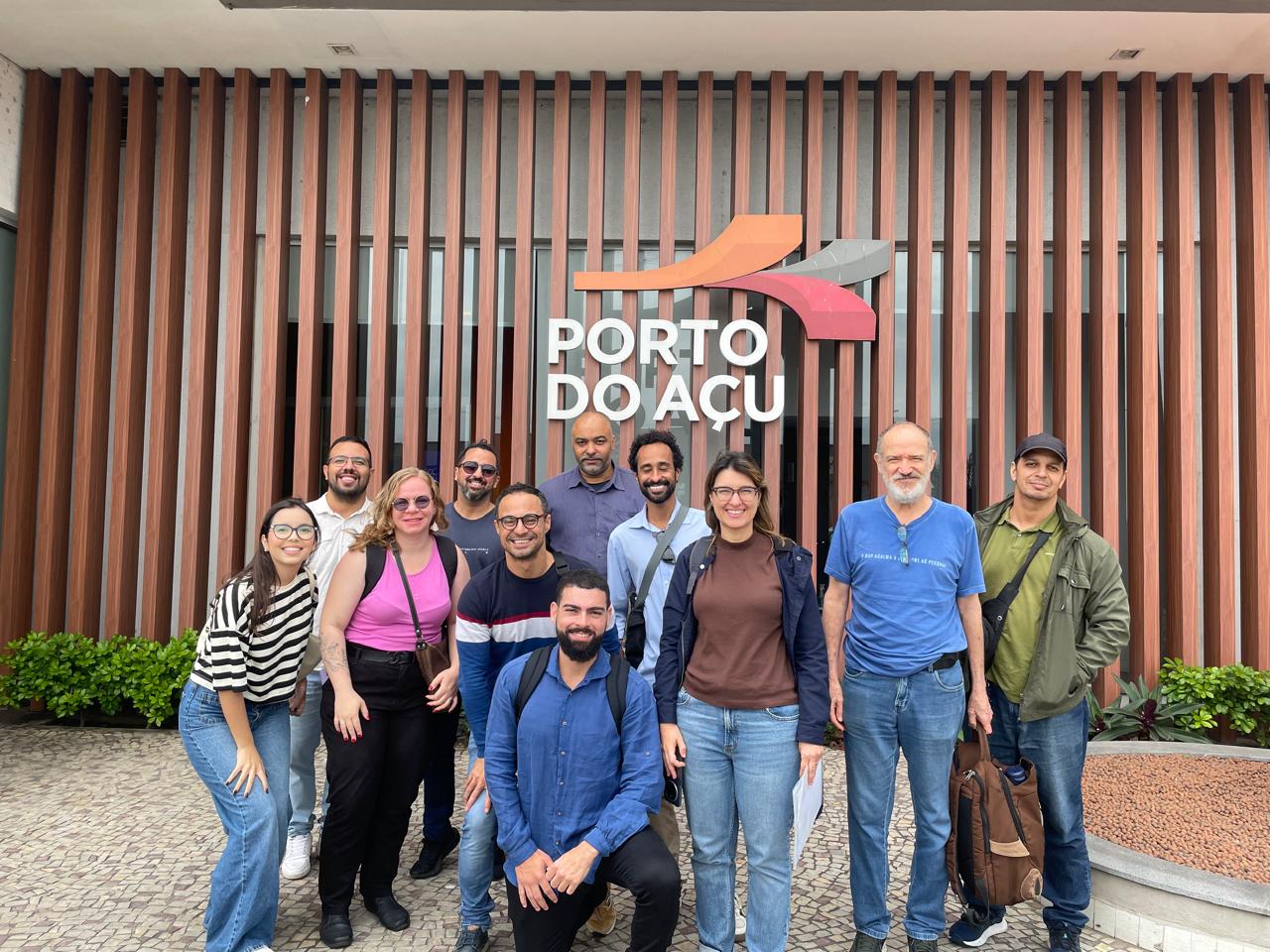
Photo: authors.
Building on authors such as Karl Polanyi, Michel Callon, and Jamie Peck, Espacio & Poder’s research has problematized market formation not as a natural phenomenon but as socio-technical and institutional arrangements, shaped by public policies, regulatory frameworks, and corporate practices.
The visit allowed in situ observation of ongoing territorial reconfiguration and the contradictions between the “green transition” discourse and the neoliberal forms of infrastructure provision. Originally designed as a support hub for the oil and mining industry, the Port of Açu may become a laboratory for the commodification of nature in the context of the energy transition, where wind and solar energy are transformed into energy assets under corporate governance and state incentives. In this process, the State acts as a guarantor of market conditions, while the territory is reconfigured to serve global decarbonization chains—a movement that, far from neutralizing inequalities, tends to reproduce patterns of dependency and green extractivism.
The field activity also allowed reflection on the financialization of infrastructures and the role of fixed territorial capital in expanding energy and logistics markets. In this sense, the Port of Açu exemplifies how the boundaries between infrastructure, nature, and territorial control are reconfigured by neoliberal commodification. This is a process that transforms territories into platforms of value creation and reinforces the “tripod of contemporary capitalism”: financialization, platformization, and neoliberal hegemony, as proposed by Pessanha (2024).

Photo: authors.
The field research reinforces Espacio & Poder’s commitment to connecting teaching, research, and outreach, and to producing critical analysis of the territorial effects of the energy transition in Brazil. The group aims to deepen the debate in future publications and activities, contributing to reflections on conditions for a just transition, with benefit redistribution, energy sovereignty, and social participation in decision-making processes.
References
BRANDÃO, C. Crises e rodadas de neoliberalização: impactos nos espaços metropolitanos e no mundo do trabalho no Brasil. Cadernos Metrópole, São Paulo, v. 19, n. 38, 2017.
BRANDÃO, Carlos. Construção social de uma variedade de mercados: capitalização de rendas e capitalismo de plataforma. GEOUSP – Espaço e Tempo, São Paulo, v. 28, n. 1, e-211385, jan./abr. 2024. DOI: 10.11606/issn.2179-0892.geousp.2024.211385. Disponível em: https://www.revistas.usp.br/geousp/article/view/211385. Acesso em: 30 out. 2025.
CALLON, M. Revisiting Marketization: From Interface-Markets to Market-Agencements. Consumption Markets & Culture, v. 19, n. 1, p. 17–37, 2016.
DARDOT, P.; LAVAL, C. A nova razão do mundo: ensaio sobre a sociedade neoliberal. São Paulo: Boitempo, 2016.
PESSANHA, R. M. Infraestrutura digital, extrativismo Hi-Tech (ExHT) e capitalismo de plataformas: artérias digitais escancaradas da América Latina – Uma homenagem a Galeano. In: PEREIRA JÚNIOR, E. et al. (orgs.). As geografias da economia política da América Latina. Rio de Janeiro: Consequência, 2024.
WERNER, D.; BRANDÃO, C. Infraestrutura e produção social do espaço: anotações sobre suas principais mediações teóricas. Revista Brasileira de Gestão e Desenvolvimento Regional, v. 15, n. 5, 2019.
WERNER, Deborah. Marketization y neoextractivismo en la generación de energía eólica offshore en el estado de Río de Janeiro, Brasil. Revista de geografía Norte Grande, Santiago, n. 92, set. 2025. DOI: 10.4067/S0718-34022025000300106. Disponível em: https://www.scielo.cl/scielo.php?script=sci_arttext&pid=S0718-34022025000300106. Acesso em: 30 out. 2025.
Originally published in IPPUR Bulletin No. 92, December 15, 2025
